Search Results
Search this site
2512 results found with an empty search
- Mi.P673
22nd October 1945 Mi.P673 22nd October 1945 Mi.P673 1/1 British Zone postcard (Mi.P673) with HAGEN (WESTF) 1 cancel and local post office proof of purchase hand stamp (faint purple circle). Ref: 22.10.1945 - 34/36 Letter that accompanied the postcard when purchased. The text refers to the present postcard (Mi.P673) and is an enquiry from Willi Driesen, most likely a relative of the original 'Absender', Gerh. Driesen of Hagen-Haspe. Ref: 34/36 The reply reads, in part, 'At the end of the war, the postage stamps and postcards with value imprints used in the "Third Reich" were withdrawn. As a replacement for the postcards with value imprint, postcards with the imprinted note "6 Rpf paid" were issued by the postal administration for a transitional period - despite several enquiries we were unable to determine the exact period. In addition to the note "6 Rpf paid", a rubber stamp with the inscription of the issuing office was printed on the postcards. The imprint of this stamp was to prove that the postcards had been paid for. The "6 Rpf paid" mark was cancelled by the usual daily postmark imprint.' Contact Brief History to inform us of additional information regarding this page
- Focke-Wulf Fw 200 Condor
5th June 1940 Focke-Wulf Fw 200 'Condor' 05.06.1940 Condor reverse.jpeg 05.06.1940 Condor reverse.jpeg 1/1 Postcard depicting a Focke-Wulf Fw 200 'Condor'. Note that the swastika on the tail has been partially obliterated. Featuring to the reverse a lesser seen Luftwaffe emblem in a triangular vignette. Ref: 05.06.1940 Also see 34/34 Link to Luftwaffe Eagle vignettes Focke-Wulf Fw 200 'Condor' The Focke-Wulf Fw 200 Condor , also known as Kurier (German for courier ) to the Allies, is a German all-metal four-engined monoplane originally developed by Focke-Wulf as a long-range airliner. A Japanese request for a long-range maritime patrol aircraft led to military versions that saw service with the Luftwaffe as long-range reconnaissance and anti-shipping/maritime patrol bomber aircraft. The Luftwaffe also made extensive use of the Fw 200 as a transport aircraft. It achieved success as a commerce raider until mid-1941, by which time it was being harried by long-range RAF Coastal Command aircraft and the Hurricane fighters being flown from CAM ships. The Fw 200 was operated by Deutsche Luft Hansa, DDL and Luft Hansa's Brazilian subsidiary Syndicato Condor. Dai Nippon KK of Japan also ordered Fw 200 airliners. These could not be delivered to Japan once the war began, so they were delivered to Deutsche Luft Hansa instead. On 14th April 1945 an Fw 200 flew Luft Hansa's last scheduled service before the end of World War II, from Barcelona to Berlin. Other airlines continued to operate the Fw 200 after the end of World War II. The first prototype, the Fw 200 V1, upgraded with extra fuel tanks and re-designated Fw 200 S-1, made several record flights. It was the first heavier-than-air craft to fly nonstop between Berlin and New York City, about 4,000 miles (6,400 km), making the flight from Berlin-Staaken to Floyd Bennett Field on 10th-11th August 1938 in 24 hours and 56 minutes. The return trip on 13th August 1938 took 19 hours and 47 minutes. These flights are commemorated with a plaque in Böttcherstraße, a street in Bremen. Beginning on 28th November 1938 it flew from Berlin to Tokyo via Basra, Karachi and Hanoi. The German Foreign Minister, Joachim von Ribbentrop, used a specially outfitted Condor 'Grenzmark', on his two flights to Moscow in 1939, during which he negotiated and signed the 'Treaty of Non-Aggression between Germany and the Soviet Union', better known as the Molotov–Ribbentrop Pact. His aircraft bore the German civil registration of D-ACVH. A Danish-owned Fw 200 aircraft named Dania was seized by the British at Shoreham Airport after Denmark was invaded by German forces in 1940. It was subsequently operated by the British Overseas Airways Corporation (BOAC) and was then pressed into service with the Royal Air Force. It was damaged beyond repair in 1941. The Luftwaffe initially used the aircraft to support the Kriegsmarine , making great loops out across the North Sea and, following the fall of France, the Atlantic Ocean. The aircraft was used for maritime patrols and reconnaissance, searching for Allied convoys and warships that could be reported for targeting by U-boats. The Fw 200 could also carry a 1,000-kilogram (2,200 lb) bomb load or naval mines to use against shipping, and it was claimed that from June 1940 to February 1941, they sank 331,122 tonnes (365,000 tons) of shipping despite a rather crude bombsight. The attacks were carried out at extremely low altitude in order to 'bracket' the target ship with three bombs; this almost guaranteed a hit. Winston Churchill called the Fw 200 the 'Scourge of the Atlantic' during the Battle of the Atlantic due to its contribution to the heavy Allied shipping losses. Following the debut of what would become the Luftwaffe's primary seaborne maritime patrol aircraft, the rival trimotored BV 138C flying boat in March 1941; from mid-1941, Condor crews were instructed to stop attacking shipping and avoid all combat in order to preserve numbers. In August, the first Fw 200 was shot down by a CAM ship-launched Hawker Hurricane, and the arrival of the U.S.-built Grumman Martlet, operating from the Royal Navy's new escort carriers, posed a serious threat. The six Martlets operated by the Royal Navy from the first escort carrier HMS Audacity shot down a total of seven Condors while escorting three convoys during her short career in the final months of 1941. On 14th August 1942, an Fw 200C-3 was the first German aircraft to be destroyed by USAAF pilots, after it was attacked by a Curtiss P-40C Warhawk and a Lockheed P-38F Lightning over Iceland. The Fw 200 was also used as a transport aircraft, notably flying supplies into Stalingrad in 1942. After late-1943, the Fw 200 came to be used solely for transport. For reconnaissance, it was replaced by the Junkers Ju 290, and even some examples of the Heinkel He 177 Greif bombers serving with Kampfgeschwader 40. With the Allied advance into France, maritime reconnaissance by the Luftwaffe became impossible as the Atlantic coast bases were captured. Production ended in 1944 with a total of 276 aircraft produced. Several damaged Fw 200s landed in Spain during the war. In the beginning, they were repaired and returned to their bases in France. After Operation Torch (the Allied invasion of French North Africa), the Spanish government interned four aircraft that arrived on Spanish territory (although their crews were still allowed to return to Germany). Since the aircraft could not be used, they were sold by Germany to Spain. One of the three flyable aircraft was then operated by the Spanish Air Force and the others used for spares. Because of damage and lack of spares, and for political reasons, they were grounded and scrapped around 1950. Some Condors also crashed in Portugal. Their crews were allowed to return to Germany while the British authorities were allowed to inspect the aircraft and accompanying documentation. Some crew members died in these crashes and were buried in the civilian cemetery of Moura in Alentejo Province, Portugal. The aircraft that crashed in Spain and Portugal had been based in Bordeaux-Merignac, France since 1940. Before then, the operational base of the Fw 200 squadrons had been in Denmark. At the suggestion of his personal pilot Hans Baur, Adolf Hitler specified a modified and unarmed prototype Condor, the Fw 200 V3, as his personal transport, as a replacement for his Junkers Ju 52. Originally configured as a 26-passenger Luft Hansa transport (Works No. 3099), it was reconfigured as a plush two-cabin airliner. Hitler's armchair-style seat in the cabin was equipped with a wooden table, seat-back armour plating, and a parachute in the seat cushion, with an escape hatch in the floor. In line with Hitler's aircraft preferences, it carried the markings "D-2600" and was named 'Immelmann II' in honour of World War I flying ace Max Immelmann. As the war progressed it changed designation to 'WL+2600' and finally '26+00'; it was destroyed at Berlin Tempelhof Airport in an Allied bombing raid on 18 July 1944. FW 200s of various types were configured as VIP transports, for the use of Hitler and his staff, and also other aircraft assigned to Heinrich Himmler, Albert Speer, Hermann Göring, and Karl Dönitz. Royal Naval Fleet Air Arm pilot Captain Eric Brown's plane was attacked and seriously damaged by a Condor in 1940, and he narrowly survived. After this, he studied the design of the Condor seriously for some time. He managed to work out that the forward firing machine gun positions could swivel, but could only fire in a certain arc otherwise they would hit the fuselage of their own plane. Brown worked out where the arc was, and realised this was a blind spot, if one attacked the front of the plane. He used this to successfully destroy a Condor, then informed his fellow squadron pilots who used the tactic to destroy others. Source: Wikipedia Contact Brief History to inform us of additional information regarding this page
- Czechoslovakia
Cover featuring a Rumburg 'Tag der Befreiung' (Liberation Day) cancel. Featuring a block of four Czechoslovakian stamps (Mi.401). Ref: 22.09.1938 - 4/23 Stamps of Czechoslovakia 22.09.1938 JB_Rumburg reverse.jpeg 22.09.1938 JB_Rumburg reverse.jpeg 1/1 Cover featuring a Rumburg 'Tag der Befreiung' (Liberation Day) cancel. Featuring a block of four Czechoslovakian stamps (Mi.401). Ref: 22.09.1938 - 4/23 Also see 18/57 Czechoslovakia - stamps within the Brief History collection Notes : On 1st October 1938 the Sudetenland was ceded by Czechoslovakia. At this time Czech postage stamps were still in use (some being overprinted with a surcharge). However, this ended on 20th October 1938 after which only German stamps became valid for postage. Bohemia & Moravia did not issue its own stamps until 15th March 1939, when it overprinted the current definitives (Mi.1-19). Like the overprinted stamps, any remaining stocks were withdrawn from sale on 1st December 1939 and they ceased to be valid after 15th December 1939. Michel list the use of Czechoslovak stamps between 15th March and the 12th April 1939 as 'Vorläufer' (forerunners - after the creation of the Protectorate and before the first issue Mi.A1 - definitive depicting President Masaryk) and 'Mitläufer' (co-runners - used after Mi.A1 and before 15th December 1939). Vorläufer - Czech stamps cancelled between 15.03 - 12.04.1939 Mitläufer - Czech stamps cancelled between 13.04 - 15.12.1939 Mi.34 (first issued 1919). Ref: 13.10.1938 Mi.37 (first issued 1919). Ref: 13.10.1938 Mi.279A (perfed on 4 sides). Ref: 30.11.1938 Mi.279B (perfed vertically). Ref: 13.10.1938 Mi.350. Ref: 06.10.1938 Mi.351. Ref: 28.09.1938 - 28/46 Mi.355. Ref: 19.07.1938 - 4/20 Mi.360. Ref: 19.07.1938 - 4/20 Mi.365. Ref: 21.09.1938 Mi.395 Zf. Ref: 19.07.1938 - 4/20 Mi.395 - aslo see 18/57 Mi.396. Ref: 03.10.1938 Mi.396 Zf. Ref: 19.07.1938 - 4/20 Mi.397. Ref: 02.10.1938 - 17/8 Mi.400. Ref: 28.09.1938 Mi.400 ZW. Ref: 19.07.1938 - 4/20 Mi.401. Ref: 28.09.1938 Mi.93 (Bohemia & Moravia) 60 H overprinted '5. V./ Československo/ 1945' in red. UNSURE OF VALIDITY. Ref: Prophila1 Mi.107 (Bohemia & Moravia) 10 K overprinted '5. V./ Československo/ 1945' in black. UNSURE OF VALIDITY. Ref: Prophila1 Contact Brief History to inform us of additional information regarding this page
- Wehrmacht Directory
WEHRMACHT WEHRMACHT 1/1 WEHRMACHT DIRECTORY The Wehrmacht were the unified armed forces of Nazi Germany from 1935 to 1945. It consisted of the Heer (army), the Kriegsmarine (navy) and the Luftwaffe (air force). The designation 'Wehrmacht' replaced the previously used term 'Reichswehr' (Reich Defence) and was the manifestation of the Nazi regime's efforts to rearm Germany to a greater extent than the Treaty of Versailles permitted. Anti-aircraft Flak 30 (used postcard). Ref: 26/5 Flak 3.7 or 5cm/ - see 26/89 Richtungshörer (Directional earpiece) Anti-tank 3.7cm Pak 36 Sonderkraftfahrzeug ( Sd.Kfz) special purpose vehicle See - https://en.wikipedia.org/wiki/List_of_Sd.Kfz._designations Sd.Kfz 161 - Panzer IV Sd.Kfz 232 - Panzerspähwagen - see 28.09.1940 Heer formations (inc. SS) FPN's (within the Brief History collection) Kriegsmarine formations FPN's (within the Brief History collection) Luftwaffe formations FPN's (within the Brief History collection) Ranks and responsibilities Contact Brief History to inform us of additional information regarding this page
- ABP Frankfurt - Machine Stamp
ABP Frankfurt: Machine Stamp (EPM) 1/0 EPM1.1 - see 33/84 EPM1.2 - see 33/68, 34/28 Contact Brief History to inform us of additional information regarding this page
- Paul Koch Ka Be
Commercial postcard issued by Paul Koch and advertising the 'Ka-Be' range of stamp albums. Ref: 07.09.1935 7th September 1935 Paul Koch & 'Ka-be' 07.09.1935-ka-be-reverse.jpeg 07.09.1935-ka-be-reverse.jpeg 1/1 Commercial postcard issued by Paul Koch and advertising the 'Ka-Be' range of stamp albums. Ref: 07.09.1935 Paul Koch &'KA-BE' Further research required Also see 07.09.1935 - 24/69, 17.12.1945 - 34/29 Commercial postcard sent from Paul Koch, G.M.B.H, in Aschersleben. Link to more details for this postcard here . Ref: 10.01.1937 - 26/85 'Ka-Be' advertising vignette. Requires reference. Sheet from a 'Ka-Be' memo pad (possibly waste as the registration is so poor). To the reverse is a Mi.822 (European Postal Congress) with special cancellation dated 12.10.1942. Ref: 12.10.1942 - 26/82 Contact Brief History to inform us of additional information regarding this page
- Walter Behrens
1st March 1945 Walter Behrens 1st March 1945 Walter Behrens 1/0 Also see 12.08.1936 (Olympics) 10.01.1937 (Day of the Stamp) - 27/8 20.01.1938 18.04.1944 - 34/27 01.03.1945 - 26/19 and 17/75 Contact Brief History to inform us of additional information regarding this page
- Klickow Ein neues Angebot
Main image: Albert Klickow advertising postcard. Ref: 17.05.1933. Gallery images: Reverse of main image together with other Albert Klickow advertising postcards. 17th May 1933 Albert Klickow Albert Klickow advertising postcard (reverse). Ref: 17.05.1933 Albert Klickow advertising postcard. Ref: 12.05.1934 Albert Klickow advertising postcard (reverse). Ref: 23.07.1938 Albert Klickow advertising postcard (reverse). Ref: 17.05.1933 1/5 Main image: Albert Klickow advertising postcard. Ref: 17.05.1933. Gallery images: Reverse of main image together with other Albert Klickow advertising postcards. Aslo see 23.07.1938 23.07.1938 - 28/25 31.12.1938 (New Year 1939) 25.02.1939 (imprint III. 39. 1000) 01.04.1939 (Frohne Ostern) 19.05.1940 (using a Mi.P40 postcard (1900) with advertising) 23.07.1942 10.12.1945 No date Ref: 26/96 (25 Years of Klickow 1912-1937 - imprint VIII. 37. 1000) Consider a page for each with links backward and forward as per 'News in Brief' For further images see Bender Vol 1, pp.64-68 Contact Brief History to inform us of additional information regarding this page
- H.C. Robert
24th February 1943 H.C. Robert 24th February 1943 H.C. Robert 1/1 Commercial cover sent from stamp dealer H.C. Robert in Köln to a correspondent in Preßnitz (no longer inhabited due to the building of a reservoir in the 1970s). The cover features the single use of supplementary postage stamp Mi.830. The postage stamp illustrated is the 5+3 Pf from the German emergency aid (Mi.590 Regional Costumes) issue. The image depicts a vineyard worker from Rhineland (Rudesheimer Berg). Ref: 24.02.1943 - 16/89 Also see 34/25 (cover variation) H.C. Robert Notes: 'The recipient HC Robert was an old Cologne resident, stamp dealer and local issue manager in Unna in 1945.' Source: philaseiten.de Further research required Contact Brief History to inform us of additional information regarding this page
- Mi.894-895
Mi.894 - 895 (June 1944) Reich Labour Service (RAD) Mi.894 - 895 (June 1944) Reich Labour Service (RAD) 30.07.1944 Exhibition of RAD stamps reverse.jpeg 30.07.1944 Exhibition of RAD stamps reverse.jpeg 1/1 Postcard (possibly self-addressed by a collector) postmarked Vienna and addressed to Bückeburg. Featuring Mi.894 and Mi.895, issued for the Exhibition of Reich Labour Service (RAD). Note: The commemorative cancellation (JB:Wien111/769) was the last special postmark for Vienna during the 3rd Reich period. Ref: 30.07.1944 - 34/24 Mi.894-895 Exhibition of Reich Labour Service (RAD) Philatelic catalogues list these stamps as issued in June 1944 (with no day or month details available) Mi.894. Ref: 30.07.1944 - 34/24 Mi.895. Ref: 30.07.1944 - 34/24 Contact Brief History to inform us of additional information regarding this page
- Bochmann Halle
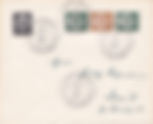
Self-addressed cover sent within Halle. Featuring various postage stamps, including sequence S154. Also featuring special cancellation JB:Halle13/343. Ref: 08.01.1938 - 17/7 8th January 1938 JB: Halle 1/1 Self-addressed cover sent within Halle. Featuring various postage stamps, including sequence S154. Also featuring special cancellation JB:Halle13/343. Ref: 08.01.1938 - 17/7 HALLE cancellations as featured in the Bochmann catalogues (1952) JB: Halle13/343 - 'Deutsche Sammler Gemeinschaft/ Sammlerschau/ Haendel'. Ref: 08.01.1938 - 17/7 JB:Halle14/343 - see 28/7 GENERIC CANCELLATIONS JB:413/842 (K - 6 Str., Halle) - see 34/22. Note JB states that this generic cancel was used between 21.02.1944 - 11.01.1945 in 53 towns and cities. This cancel has been used in Halle on 19.02.1945 , over a month later Contact Brief History to inform us of additional information regarding this page
- MHB 69
18th March 1942 MHB 69 18.03.1942 MHB 69 reverse.jpeg 18.03.1942 MHB 69 reverse.jpeg 1/1 Registered cover sent from Munich to Bamberg. Featuring various stamp combinations including KZ38 (Mi.782 + Z + Z + Mi.784) from MHB 69. Ref: 18.03.1942 Stamp sequences from booket sheet MHB 69 KZ 38 (Mi.782 + Z + Z + Mi.784) from MHB 69. Ref: 18.03.1942 S270 (Mi.784 + Mi.781) from MHB 69. Ref: 05.11.1941 S272 margin piece (Mi.781+Mi.784) from MHB 69. Ref: 22.04.1942 - 32/42 W149 (Mi.785 + Mi.783) from MHB 69. Ref: 04.02.1942 - 15/6 Stamps sequence from MHB 69. Ref: 21.04.1942 - 17/61, also noted on 19.02.1945 - 34/22 Contact Brief History to inform us of additional information regarding this page