Search Results
Search this site
2513 results found with an empty search
- Mi.894-895
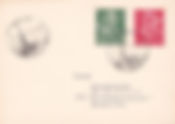
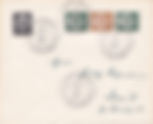
Mi.894 - 895 (June 1944) Reich Labour Service (RAD) Mi.894 - 895 (June 1944) Reich Labour Service (RAD) 30.07.1944 Exhibition of RAD stamps reverse.jpeg 30.07.1944 Exhibition of RAD stamps reverse.jpeg 1/1 Postcard (possibly self-addressed by a collector) postmarked Vienna and addressed to Bückeburg. Featuring Mi.894 and Mi.895, issued for the Exhibition of Reich Labour Service (RAD). Note: The commemorative cancellation (JB:Wien111/769) was the last special postmark for Vienna during the 3rd Reich period. Ref: 30.07.1944 - 34/24 Mi.894-895 Exhibition of Reich Labour Service (RAD) Philatelic catalogues list these stamps as issued in June 1944 (with no day or month details available) Mi.894. Ref: 30.07.1944 - 34/24 Mi.895. Ref: 30.07.1944 - 34/24 Contact Brief History to inform us of additional information regarding this page
- Bochmann Halle
Self-addressed cover sent within Halle. Featuring various postage stamps, including sequence S154. Also featuring special cancellation JB:Halle13/343. Ref: 08.01.1938 - 17/7 8th January 1938 JB: Halle 1/1 Self-addressed cover sent within Halle. Featuring various postage stamps, including sequence S154. Also featuring special cancellation JB:Halle13/343. Ref: 08.01.1938 - 17/7 HALLE cancellations as featured in the Bochmann catalogues (1952) JB: Halle13/343 - 'Deutsche Sammler Gemeinschaft/ Sammlerschau/ Haendel'. Ref: 08.01.1938 - 17/7 JB:Halle14/343 - see 28/7 GENERIC CANCELLATIONS JB:413/842 (K - 6 Str., Halle) - see 34/22. Note JB states that this generic cancel was used between 21.02.1944 - 11.01.1945 in 53 towns and cities. This cancel has been used in Halle on 19.02.1945 , over a month later Contact Brief History to inform us of additional information regarding this page
- MHB 69
18th March 1942 MHB 69 18.03.1942 MHB 69 reverse.jpeg 18.03.1942 MHB 69 reverse.jpeg 1/1 Registered cover sent from Munich to Bamberg. Featuring various stamp combinations including KZ38 (Mi.782 + Z + Z + Mi.784) from MHB 69. Ref: 18.03.1942 Stamp sequences from booket sheet MHB 69 KZ 38 (Mi.782 + Z + Z + Mi.784) from MHB 69. Ref: 18.03.1942 S270 (Mi.784 + Mi.781) from MHB 69. Ref: 05.11.1941 S272 margin piece (Mi.781+Mi.784) from MHB 69. Ref: 22.04.1942 - 32/42 W149 (Mi.785 + Mi.783) from MHB 69. Ref: 04.02.1942 - 15/6 Stamps sequence from MHB 69. Ref: 21.04.1942 - 17/61, also noted on 19.02.1945 - 34/22 Contact Brief History to inform us of additional information regarding this page
- Hannover Der neue Weg
17th October 1945 "Der neue Weg" 17th October 1945 "Der neue Weg" 17.10.1945 Hannover reverse.jpeg 17.10.1945 Hannover reverse.jpeg 1/1 Cover sent from Hannover to Hamburg featuring the sloagn date stamp 'Hannover I/ Austtellung/ "Der neue Wey"'. Lesser seen cancellation (ref: JB: Hannover71/370). With German printing 6 Pf stamp (Mi.20). Ref: 17.10.1945 - 34/21 "Der neue Weg" Following this external link to further information on "Der neue Weg" cancellations Contact Brief History to inform us of additional information regrding this page
- Bochmann Dresden
Self-addressed CTO sent from Dresden featuring JB:Dresden87/232 - '3 koloniale Tage/ d.Reichskolonialbundes'. Ref: 01.08.1938 1st August 1938 JB:Dresden 01.08.1938 Dresden Kolonial reverse.jpeg 01.08.1938 Dresden Kolonial reverse.jpeg 1/1 Self-addressed CTO sent from Dresden featuring JB:Dresden87/232 - '3 koloniale Tage/ d.Reichskolonialbundes'. Ref: 01.08.1938 DRESDEN cancellations as featured in the Bochmann catalogues (1952) JB:Dresden87/232 - '3 koloniale Tage/ d.Reichskolonialbundes'. Ref: 01.08.1938 JB:Dresden88/232 - see 19.03.1939 - 23/9 JB:Dresden91/232 - 'Deutsche Kolonial-Ausstellung'. Ref: 21.06.1939 JB:Dresden101/233 - see 33/52 JB:Dresden103/233 - see 30/60, compare to 34/20 JB:Dresden104/233 - the last special cancel for Dresden during the Third Reich. See 28/58 Post-war JB:Dresden105/233 - 'Vereinigungsparteitag/ KPD/SPD Sachsen/ 7.4.1946/ zur Sozialistischen Einheitspartei - Bühlau'. Ref: 07.04.1946 - 15/79 Notes on JB:Dresden105/233 - Lesser seen cancellation (the rubber stamp become unstable after a few hours, with use ceasing). JB:Dresden106/233 - 'Philatelistengedenktag/ zum/ Erscheinen/ des 1.Dresdener/ 23.6.1946/ Postwertzeichens/ 1945'. Ref:23.06.1946 - 15/28 GENERIC CANCELLATIONS used in numerous cities including Dresden JB:173/819 - see 04.06.1935 Contact Brief History to inform us of additional information regarding this page
Mi.65-72 (28.07.1941/1942) B&M Definitives 1/1 Parcel card for a package sent from a German soldier in Schlan/Slany in Bohemia and Moravia to Neumarkt in der Oberpfalz. Featuring two B&M definitives (Mi.71). Ref: 13.05.1942 - 7/77 Notes on the soldiers infantry battalion: The battalion was set up on 10th September 1939 in Nuremberg, in Military District XIII. The Infantry Replacement Battalion 480 was subordinate to Division 173 and provided a replacement for the 260th Infantry Division. On 20th July 1941, the battalion was relocated to Schlan in the Protectorate of Bohemia and Moravia. From that day on, the battalion was also subordinate to Division 193. On 1st October 1942, the battalion was divided into an Infantry Replacement Battalion 480 and an Infantry Training Battalion 480. Both battalions were renamed Grenadier Replacement Battalion 480 and Grenadier Training Battalion 480 on 7th November 1942. On 10th April 1943, both battalions were merged to form the Grenadier Replacement and Training Battalion 480. On 13th December 1943, the training battalion was transferred to the 271st Infantry Division and thus disbanded. As a result, the battalion was again called the Grenadier Replacement Battalion 480. On 26th March 1945, the battalion was mobilised with 6 companies, again as the Grenadier Replacement and Training Battalion 480. Mi.65 - 52 Bohemia and Moravia definitives Mi.65a (28th July) Ref: 02.09.1941 - 8/50 Mi.66b (early 1942) Ref: 20.04.1942 - 7/14 Mi.68a (28th July). Ref: 02.10.1941 - 2/120 Mi.69 (1941 or '42?). Ref: 20.04.1942 - 7/14 Mi.70 (1941 or '42?). Ref:17.01.1942 - 1/83 , compare to 7/14 Mi.71 (1941 or '42?). Ref: 13.05.1942 - 7/77 Mi.72 (1941 or '42?). Ref: 17.01.1942 - 1/83 Contact Brief History to inform us of additional information regarding this page
- Bochmann Prague
20th April 1942 JB: Prague 1/1 FRONT ONLY. Featuring various Bohemia and Moravia definitive postage stamps tied with a commemorative date cancel celebrating the birthday of Adolf Hitler. It would appear that the cover had been purchased for the special cancellation and later sent on 15.05.1942, or that the post office were still using the special birthday cancellation? Further research required. Ref: 20.04.1942 - 7/14 PRAGUE special cancellations Note: Bochmann doesn't list Prague cancellation, however, for uniformity the Brief History collection list then under this heading. 1941 'BRIEFMARKE/ 1840-1940/ POŠTOVNÍ ZNÁMKA'. Ref: 01.01.1941 - 17/38 1942 '11.I.1942/ TAG DER BRIEFMARKE/ KDF SAMMLER-GRUPPE PRAG'. Ref: 33/42 'FÜHRERS GEBURTSTAG 20.IV.1942'. Ref: 20.04.1942 - 7/14 Contact Brief History to inform us of additional information regarding this page
- Mi.813
Mi.813 (13.04.1942) Adolf Hitler's 53rd Birthday 1/1 Official postcard for 'The Soviet Paradise' Exhibition at the Lustgarten, Berlin. Featuring Mi.813 issued to celebrate Adolf Hitler's 53rd birthday. Ref: 19.06.1942 Mi.813 53rd Birthday of Adolf Hitler Notes: Design: Ernst Rudolf Vogenauer . Photogravure printing. Sheets 10 x 5. Without watermark. Perf. 14¼:13½ (14¼:13¾ Harper & Scheck). Quantity issued: unknown. Valid until 31.12.1942 Look out for large 'hole' in cap band Mi.813 (12 Pf). Ref: 20.04.1942 - 7/13 Compare with 20.04.1942 - 32/40 Contact Brief History to inform us of additional information regarding this page
- Wehrmacht ranks and responsibilities
Wehrmacht Ranks & Responsibilities Wehrmacht Ranks & Responsibilities Screenshot 2021-11-27 at 09.29.50.png Screenshot 2021-11-27 at 09.29.50.png 1/1 Wehrmacht - Ranks and Responsibilities A Abteilungsleiter (Section Leader) F Fürsorge-offizier (Welfare Officer) G Gefreiter (Lance corporal) - See 26/90 - main page for this rank (Gefreiter (Lance corporal) - with Infantry Assault Badge) H Hafenkapitän (Haka - A naval port captain, ranking below a Hafenkommandant) O Oberleutnant - see 23.02.1940 - 30/40 Oberstabzahlmeister (Senior Paymaster) - see 7/13 Oberwachmeister (Sergeant Major in the Cavalry, Artillery, A.A. etc) S Station Officer (Station Command Posts) Contact Brief History to inform us of additional information regarding this page
- General Government Postage stamps
General Government Postage stamps General Government Postage stamps 1/0 Postage stamps of the General Government Mi.1-13 (01./04.12.1939) German Post in the East (Hindenburg medallion 'OSTEN' overprint) Mi.14-15 (08./18.03.1940) Field Marshall Edward Śmigty-Rydz - Polish stamps with surcharge overprint Mi.16 (08./18.03.1940) President Ignacy Moscicki - Polish stamp with surcharge overprint Mi.17-29 (08./18.03.1940) Anniversary of the Republic of Poland - Polish stamps with surcharge overprint Mi.30-32 (08./18.03.1940) Winter Welfare - Polish stamps with surcharge overprint Mi.33-34 (08.03.1940) Queen Jadwiga and King Jagiello of Lithuania - Polish stamps with surcharge overprint Mi.35-39 (18.03.1940) Postage due stamps from Poland - Polish stamps with surcharge overprint Mi.40-51 (05.08./05.09.1940) Regular issue - Buildings Mi.52-55 (17.08.1940) Red Cross Mi.56-58 (26.10.1940) 1st Anniversary of the General Government Mi.59-61 (01.12.1940) Winter Relief Mi.63-65 (20.04./10.07.1941) Buildings - see 22.05.1941 - 32/99 (Mi.63) Mi.66-70 (15.08./08.09.1941) Regular issue - Buildings Mi.71-82 (26.10.1941) Regular issue - Adolf Hitler Mi.83-88 (07.04.1942/1944) Regular issue - Adolf Hitler Mi.89-91 (20.04.1942) 53rd Birthday of Adolf Hitler Mi.92-95 (15.08.1942) 600th Anniversary of City of Lubin see 03.10.1942 (Mi.GG94) Mi.96-100 (20.11.1942) Cultural figures Mi.101-103 (20.04.1943) 54th Birthday of Adolf Hitler Mi.104 (23.05.1943) 400th Anniversary of the death of Nicolaus Copernicus (As Mi.100 but in a different colour and vertical death date - also in a commemorative sheet of 5x2) Mi.105-109 (13.08./14.09.1943) 3rd Anniversary of the NSDAP in the General Government Mi.110-112 (25.06./15.07.1943) Regular issue - Adolf Hitler Mi.113-116 (10.04.1943/11.02.1944) Regular issue - Buildings Mi.117-119 (20.04.1944) 55th Birthday of Adolf Hitler Mi.120-124 (15.07.1944) Cultural figures Mi.125 (26.10.1944) 5th Anniversary of the General Government Official Stamps Mi.1-15 (01.04./05.04.1940) Official Stamps - sovereignty symbol - Large format Mi.16-24 (22.07./05.08.1940) Official Stamps - sovereignty symbol - Small format Mi.25-36 (02.1943) Official Stamps - sovereignty symbol over Krakow Castle Delivery Stamps Mi.1-4 (01.12.1940) Delivery stamps - numerals in oval decoration Radio Stamps Mi.1-2 (01.07.1940) Radio stamps - '4/Rundfunk' and 'A/Rundfunk' Contact Brief History to inform us of additional information regarding this page
- Mi.101-103 General Government
GG Mi.101-103 (20.04.1943) GG Mi.101-103 (20.04.1943) 1/0 M.101-103 (complete) - see 26/37 Contact Brief History to inform us of additional information regarding this page
- Mi.816-817
Mi.816 - 817 (08.08.1942) 1/1 Stamps issued for the 10th anniversary of the German Association for goldsmith art. Main image: Mi.816, secondary image: Mi.817. Both Ref: 11.08.1942 Mi.816 - see 7/12 next stamp issue Self-addressed registered cover sent to/from Plauen. Featuring stamps Mi.816 and Mi.817. Ref: 11.08.1942 Reverse Contact Brief History to inform us of additional information regarding this page