Search Results
Search this site
2512 results found with an empty search
- Bochmann Bautzen
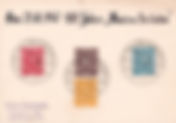
23rd August 1947 JB: Bautzen 23rd August 1947 Bochmann Bautzen Front only with caligraphic script for the 'Maćica Serbska' cultural organisation. Featuring various '1st Control' definitives together with special cancellation JB:Beutzen8/82. Ref: 23.08.1947 - 17/17 BAUTZEN cancellations as featured in the Bochmann catalogues (1952) JB:Bautzen4/81 - 33/40 JB:Bautzen7/81 - 34/59 JB: 155/817 (Bautzen) - 18/60 - JB:Bautzen:8/82 - '100 Jahre/ Maćica Serbska/ Budysin/ 23.8.1947'. Ref: 23.08.1947 - 17/17 Notes on 'Maćica Serbska' (JB:Bautzen:8/82): Maćica Serbska – the oldest cultural association of the Serbołużic people, existing in the years 1845–1948, reactivated in 1990. The activity of Maćica Srpska was interrupted in 1937 by the national socialist authorities of Germany. At that time, the last, 170th issue of Časopis was published. In 1941, the remaining property of the organisation was confiscated – the Serbian House became the property of the city of Bautzen, and the Maćica collections were transferred to the city museum. In 1945, during the battles for Bautzen, the Serbian House was damaged. After World War II, the association resumed its activities to a limited extent, focusing mainly on the fields of linguistics and history. As a result of the consolidation of cultural organisations ordered by the Saxon authorities, Maćica was incorporated into Domowina in 1948, where it operated as its 'Scientific Department' for a year. In 1951, the Institute of Sorbian Folk Studies began its operations. The remains of the collections of Maćica Srpska were divided between the Institute (Central Sorbian Library, Sorbian Cultural Archive) and the Lusatian Museum. In 1956, Dom Serbian was transferred by Domowina to the East German state. Source: Wikipedia (2024) Contact Brief History to inform us of additional information regarding this page
- Meissen Obliteration Mi.31-34
Mi.31-34 (23.06.1945) Meißen Mi.31-34 (23.06.1945) Meißen Meissen Obliteration Mi.31-34 What appears to be a collectors cover featuring Meißen obliterations 'Deutschlands Verderber' (Germany's corrupter), Mi.31 and Mi.33. Ref: 15.11.1945 German Local Issues - MEISSEN - Mi.31-34 Meißen overprint Mi.32 (Ref: 15.11.1945) Meißen overprint Mi.33 (Ref: 15.11.1945) Contact Brief History to inform us of additional information regarding this page
- Sample Show of Leipzig Products Mi.124-125
Mi.124-125 (18.10.1945) Leipzig Product Show Mi.124-125 (18.10.1945) Leipzig Product Show Sample Show of Leipzig Products Mi.124-125 In October 1945 (18th-23rd October), the first trade fair after the Second World War, the Leipzig Products Sample Show , took place. This was organised by order of the Soviet Military Administration of Germany (SMAD). Only 751 exhibiting companies attracted over 90,000 visitors. The trade fair was an event 'of a trade fair nature' and was at the time rated as a complete success in expanding the exchange of goods both within the Soviet occupation zone and to Eastern Europe. Mi.124-125 Sample Show of Leipzig Products Mi.124 (6 Pf). Ref: 21.10.1945 Mi.125 (12 Pf). Ref: 21.10.1945 Mi.124 & Mi.125 on a donation receipt for 'One Reichsmark donation for the reconstruction of the city of Leipzig'. Ref: 08.12.1945 - 19/31 The need for reconstruction in Leipzig During World War II, Leipzig was repeatedly attacked by British as well as American air raids. The most severe attack was launched by the Royal Air Force in the early hours of 4th December 1943 and claimed more than 1,800 lives. Large parts of the city center were destroyed, while factories experienced temporary shortfalls in production, had to move production facilities or even were decentralised. At the outbreak of the war, Leipzig had more than 700,000 inhabitants and was therefore the sixth-largest city of the 'Greater German Reich' (including Vienna). Leipzig additionally had significance by hosting the leading trade fair of the German Empire. The Erla Maschinenwerk aircraft factory that produced Messerschmitt Bf 109 fighter planes at the three locations of Heiterblick, Abtnaundorf and Mockau were important for warfare. Additionally, Leipzig was an important railroad intersection in Germany at that time. In May 1944 more than 15,000 buildings were hit. Among them, more than 4,000 were destroyed completely, more than 1,000 heavily and over 10,000 slightly damaged. According to a preliminary official report from 30th December 1944, the regions which were mainly hit were the ring around the inner city, the directly adjacent areas to the west, north and east, as well as all the southern suburbs. The adjacent areas to the north and east were slightly affected, whereas no damage occurred in the outer west, southwest and northwest. About 140,000 people were left homeless. On 23 February 1945 Leipzig received two major bombings: one by the British, and another by the Americans. Source: Wikipedia Contact Brief History to inform us of additional information regarding this page
- Postcard Directory
Postcard Directory Postcard Directory Postcard Directory List of series titles and publishers of illustrated postcards Die Deutsche Wehrmacht - Leutert & Schneidewind - See 28.08.1940 (Karte 30) Eric Gutjahr Bildverlag (colour postcard series of artists depictions of war) - See 34/37 (Nr.89), 34/38 (Nr.73), 34/39 (Nr.89), 34/40 (Nr.69), 34/41 (Nr.81), 34/42 (Nr.76) Wehrmachtsfoto - Heinz Schröter, Osnabrück - See 11.04.1936 (15ab/10) Contact Brief History to inform us of additional information regarding this page
- Ich versichere, daß dieser...
30th July 1945 'Ich versichere, daß dieser...' 30th July 1945 Ich versichere, daß dieser... See 30.07.1945 - hand stamp notification Ich versichere, daß dieser Brief keine persönlichen Mittellungen enthält. Sein Inhalt ist für die öffentlichen belange von Wichtigkeit. I assure you that this letter does not contain any personal information. Its contents are of public importance. Contact Brief History to inform us of additional information regarding this page
- Grossraschen Local Issue
Mi.1-12 (01.09.1945?) Großräschen Fee Labels Mi.1-12 (01.09.1945?) Großräschen Fee Labels Grossraschen Local Issue Collectors cover featuring a full issue of the Großräschen feel labels (issued in September 1945 - no exact date). Address obliterated but the reverse date stamp indicates its arrival in Halle three days later. Ref: 24.11.1945 - 19/34 Mi.1 - Mi.12 Großräschen Local Issues Mi.1 - 3 Pf - Without hammer. Lower edge margin piece. Ref: 24.11.1945 - 19/34 Mi.2 - 4 Pf. Without hammer. Ref: 24.11.1945 - 19/34 Mi.3 - 5 Pf. Without hammer. Ref: 24.11.1945 - 19/34 Mi.4 - 6 Pf. Ref: 24.11.1945 - 19/34 Mi.5 - 8 Pf. Without hammer. Ref: 24.11.1945 - 19/34 Mi.6 - 10 Pf. Without hammer. Ref: 24.11.1945 19/34 Mi.7 - 12 Pf - Right edge margin piece. Ref: 24.11.1945 19/34 Mi.8 - 20 Pf. Ref: 24.11.1945 - 19/34 Mi.9 - 24 Pf. Ref: 24.11.1945 - 19/34 Mi.10 - 30 Pf - Upper edge margin piece. Ref: 24.11.1945 - 19/34 Mi.11 - 40 Pf. Ref: 24.11.1945 - 19/34 Mi.12 - 60 Pf. Ref: 24.11.1945 - 19/34 Contact Brief History to inform us of additional information regarding this page
- Concentration Camp Directory
Concentration Camp Directory Concentration Camp Directory Concentration Camp Directory Concentration Camp Directory (camp/date source: Simon, 1973. Sub-camps to be added at a later date) Amersfoort 08.1941 - 05.1945, Ankenbuck (Baden) - 04.1933 - 01.1934 Auschwitz (Oswiecim) 05.1940 - 01.1945 'Konzentrationslager Auschwitz' envelope date stamped 14.11.1941 Friedrich Boos and construction within Auschwitz Envelope/letter postmarked Auschwitz from FPN 45510 (possibly 394th Landesschützen Battalion - some of whom were tasked with POW guard duty) - see 29.04.1942 - 32/43 Bad Sulza (Thuer.) 07.1933 - 07.1937, Bergen-Belsen (Hann.) 07.1943 - 04.1945, Boergermorr (Hann.) 1933 - 1934, Brandenburg 03.1933 - 04.1934, Brauweiler 06.1933 - 04.1934, Breitenau (Hessen) 11.1933 - 1934, Buchenwald (nr. Weimar) 07.1937 - 04.1945, Colditz (Sachsen) 07.1933 - 05.1934, Columbia House (Berlin) 01.1935 - 11.1936 Dachau (nr. Munich) 03.1933 - 04.1945 Memorial card for a Belgian inmate in F.F.I. (March 1945) - 26/87 Druette (Braunschweig) 11.1942 - 04.1945, Esterwegen (Hann.) 03.1933 - 09.1936, Flossenbuerg (Bavaria) 05.1938 - 04.1945, Fuhlsbuettel (Hambg) 09.1933 - 01.1937 Gross-Rosen (Silesia) 08.1940 - 02.1945 Memorial card for a Belgian inmate (January 1945) Gusen (Langenstein) 05.1940 - 05.1945, Hammerstein (Posen) 1933 - 1935, Heuberg (Baden) 05.1933 - 11.1933, Herzogenbosch 01.1943 - 09.1944, Hohnstein (Sachsen) 12.1933 - 08.1934, Kemma (Rhein) 07.1933 - 01.1934, Lichtenburg (Torgau) 06.1933 - 08.1937/ 03.1938 - 05.1939, Mauthhausen (Linz) 08.1938 - 05.1945, Moringen (Hann.) 03.1933 - 11.1933, Natzweiler 07.1941 - 09.1944 Neuengamme (Hambg) 12.1938 - 04.1945 Origins of sub-camp at Beendorf Neusustrum (Hann.) 1933 - 04.1945, Oranienburg (Berlin) 06.1933 - 05.1945, Osthofen (Hessen) 04.1933 - 08.1933, Papenburg (Hann.) 1934 - 04.1945, Ravensbrueck (Brandb'g) 05.1939- 04.1945, Sabac (Serbia) 05.1941 - 09.1943Sachsenburg (Sachsen) 05.1933 - 09.1937, Sachsenhausen (Berlin) 08.1936 - 04.1945, Sonnenburg (Brandb'g) 04.1933 - 04.1934, Stettin-Bredow 02.1933 - 02.1934, Stutthof (Danzig) 01.1942 - 01.1945, Theresienstadt (Prague) 11.1941 - 05.1945, Ulm-Kuhberg (Wttbg) 11.1933 - 07.1933, Werden (Rhein) 06.1933 - ????, Westerbork (Holland) 06.1942 - 04.1945 Sachsenhausen/ Oranienburg Postcard - SS-Lager Oranienburg Sachsenhausen postal stationery - Postkarte - See 30/8 (1939) Stutthof Cancellation that could be used to tell the story. Tenuous. Wieda Sub-camps for inmates from Buchenwald, MittelbauI, and Sachsenhausen Wittmoor (Hambg) Contact Brief History to inform us of additional information regarding this page
- Anschar Nasshan
10th December 1947 Anschar Nesshan 10th December 1947 Anschar Nasshan Commercial postcard sent from 'Anschar Nasshan Briefmarkenversand' in Kaltenkirchen to an address in Barsinghausen. Ref: 10.12.1947 - 16/63 Anschar Nasshan Further research required Contact Brief History to inform us of additional information regarding this page
- Bridges
Bridges Bridges Bridges Bridges Road and rail bridges of Germany Köln - Mülheimer Hängebrücke - see 20.08.1933 - 34/88 Leipzig - Zeppelinbrücke - see 11.01.1943 - 7/11 München-Landesgrenze - Mangefallbrücke - see 1.08.1936 - 34/95 Rendsburg - Hochbrücke - see 19/6 Contact Brief History to inform us of additional information regarding this page
- Mi.907
Mi.907 (06.01.1945) Mi.907 (06.01.1945) Mi.907 Mi.907 (Ref: 27.01.1945) next stamp issue
- Stamps of Poland
Stamps of Poland Stamps of Poland Stamps of Poland Poland - stamps within the Brief History collection (including the stamps issued by the Polish Government in Exile) 1941 Polish Government in Exile Mi.360 (Gr 5) - United States Embassy ruins, Warsaw. Ref: Prophila7 Mi.362 (Gr 25) - Destruction of Mickiewicz monument, Krakow. Ref: Prophila7 Mi.363 (Gr 55) - Ruins of the Castle Square, Warsaw. Ref: Prophila7 Mi.365 (Gr 80) - Armoured tank. Ref: Prophila7 1943 Polish Government in Exile Mi.368 (Gr 5) - Polish aircraft in the battle of the Atlantic. Ref: Prophila7 Mi.369 (Gr 10) - Polish Merchant navy. Ref: Prophila7 Mi.370 (Gr 25) - Polish army in France. Ref: Prophila7 Mi.371 (Gr 55) - Polish soldiers in Narvik. Ref: Prophila7 Mi.373 (Gr 75) - Polish army in Libya. Ref: Prophila7 Mi.373 (Gr 80) - Polish army in Middle-East with General Sikorski. Ref: Prophila7 Mi.375 (Zł 1 Gr 50) - Underground printing press in Poland. Ref: Prophila7 1944 Polish Government in Exile Mi.376 (Gr 45) - Capture of Monte Cassino by the Poles. Ref: Prophila7 Mi.377 (Gr 55) - Capture of Monte Cassino by the Poles. Ref: Prophila7 Mi.378 (Gr 80) - Capture of Monte Cassino by the Poles. Ref: Prophila7 Mi.379 (Zł 1 Gr 20) - Capture of Monte Cassino by the Poles. Ref: Prophila7 On 17th May, General Anders led the Polish II Corps in launching their second attack on Monte Cassino. Under constant artillery and mortar fire from the strongly fortified German positions and with little natural cover for protection, the fighting was fierce and at times hand-to-hand. With their line of supply threatened by the Allied advance in the Liri valley, the Germans decided to withdraw from the Cassino Heights to the new defensive positions on the Hitler Line. In the early hours of 18th May , the British 78th Division and Polish II Corps linked up in the Liri valley, 2 miles (3.2 km) west of Cassino town. On the Cassino high ground, the survivors of the second Polish offensive were so battered that 'it took some time to find men with enough strength to climb the few hundred yards to the summit.' A patrol of the Polish 12th Podolian Cavalry Regiment finally made it to the heights and raised a Polish flag over the ruins. The only remnants of the defenders were a group of thirty German wounded who had been unable to move. Source: Wikipedia Contact Brief History to inform us of additional information regarding this page
- Pages from Punch Child of 1945
3rd January 1945 Pages from 'PUNCH' 3rd January 1945 Pages from Punch Child of 1945 Cartoon form PUNCH magazine 3rd January 1945. Father time holds the hand of the anxious '1945' child. The caption reads NUMBER SEVEN "Yes, you will have to fight as hard as your brothers, my boy, and maybe fight harder." Contact Brief History to inform us of additional information regarding this page