


24th November 1941
Mautern, Stein, Krems a.D.


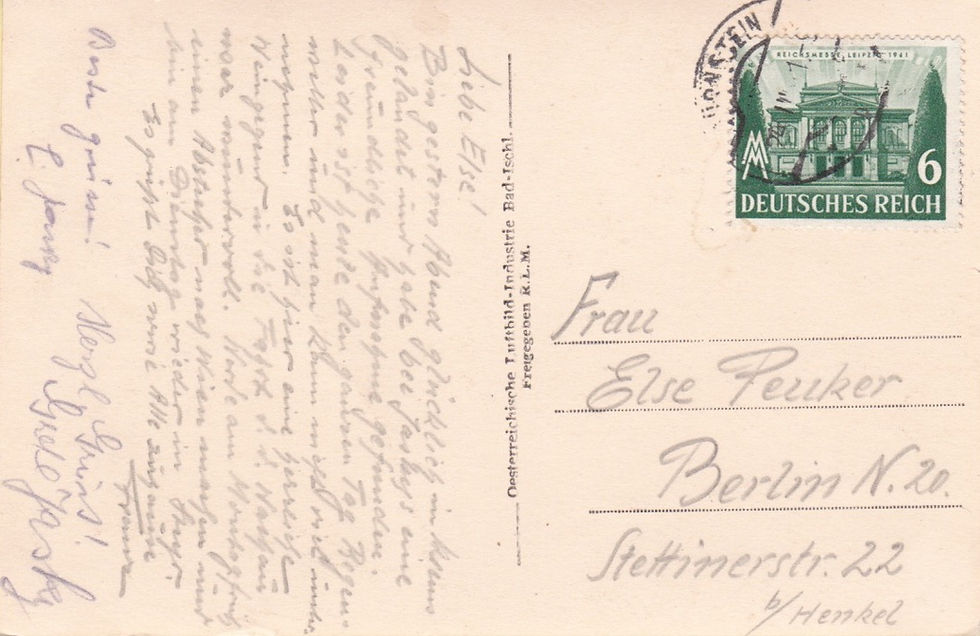
Postcard depicting aerial views of Mautern (in the foreground), Stein (across the bridge), and Krems in the distance. All situated along the Danube (Donau) river in the Wachau valley. Ref: 24.11.1941
Mautern, Stein, and Krems a.D.

Mautern a.D.
In former times ships cruising the Danube had to pay a toll when they passed Mautern. The town got its name from there because toll translates as "Maut" in German.
Before it got this name it was called Favianae by the Romans because it was a very important fort.
Being an important merchant point in the Middle Ages, it gained additional importance as the bridge over the Danube River was built (a steelwork as of 1895).
Source: Wikipedia
Stein a.D.
(Usually described as a suburb in the city of Krems)
Krems a.D.
Krems an der Donau is a town with 25,271 inhabitants (2022) in Austria, in the federal state of Lower Austria. It is the fifth-largest city of Lower Austria and is approximately 70 kilometres (43 miles) west of Vienna. Krems is a city with its own statute (or Statutarstadt), and therefore it is both a municipality and a district.
Source: Wikipedia
Article on Stalag XVII-B, Krems-Gneixendorf
The largest labor camp of the Ostmark, STALAG XVII B Krems-Gneixendorf, detained prisoners of war and was located here. Up to 66,000 soldiers from France, Belgium, Poland, Italy, the Soviet Union, the USA and other countries were held nearby the village of Gneixendorf.
The areas in which the prisoners of war came into contact with the local population are of particular interest in the research project, especially with regards to the forced labor deployed. It were the so-called "Außenkommandos" who were assigned to agricultural and forestry enterprises as well as factories and industrial and handicraft enterprises. Forced labor also benefited the city's large-scale construction activities during the Nazi era: Among other things, forced laborers were utilized for work on expanding the harbor, building the "Schmidhütte" steel and sheet metal rolling mill and its factory housing estate in what is now the Lerchenfeld district of Krems. To accommodate them, the prisoners of war were housed in barracks or vacant premises in the immediate vicinity of their workplaces.
A topic that has remained completely unexplored to this day is the conditions of life and camps of civilian forced laborers in the district, many of them from Poland and Ukraine, who had to perform forced labor in the Krems area.
After 1944, Hungarian-Jewish forced laborers in particular were housed in other Nazi labor camps, including those in Langenlois, Dross, Furth, Mautern, Rossatz and Spitz an der Donau. The research project explores the traces these different Nazi forced labor camps have left behind, some of which are barely visible today, others which are visible but have not been identified in their historical dimension.
Source: Dr. Edith Blaschitz, Donau University, Krems
Link to page within Brief History containing postal history from Stalag XVII-B
Contact Brief History to inform us of additional information regarding this page